
At Kathmandu's two largest public hospitals, the staff who sterilize and sort medical waste by hand say they go without paid sick leave, functioning equipment, or hazard pay, despite routine exposure to HIV, hepatitis, and tuberculosis.
Deepa (name changed), with a white gown, hair cap, gloves, and boots, stands inside the unit. She has worked at Paropakar Maternity and Women's Hospital (PMWH) for 11 years. Every day, she and her colleagues sort through piles of medical waste: used gloves, syringes, stained cotton pads, plastic tubing, and masks. Materials that carry risks beyond what can be seen. 
The smell hits before the door fully opens.
Heavy, sour, pungent, unbearable, and impossible to ignore is the air inside the waste management unit of Paropakar Maternity and Women’s Hospital (PMWH) in Thapathali.
“I stand for hours in the segregation room handling the smelly, infectious, and toxic waste, but I don’t receive any benefits or incentives as other employees in other divisions of the hospital receive,” Deepa said.
PMWH’s own data for the month of Baishak 2083 B.S. (mid-April to mid-May 2026) show hazardous waste ran about 207 kg in the first week, climbed to 223 kg by the fourth.
For staff who manually segregate this waste material, these fluctuations can mean increased demand and pressure on waste management unit staff to sterilize and segregate hazardous waste during periods of high patient admission at the hospital.
Every day, hospitals in Kathmandu district produce an average of 11,315 kg of hazardous and infectious medical waste. Although waste management systems exist in many hospitals, there are many concerns about the waste handlers’ health, situation, and wages. Dealing with infectious waste can also be associated with immediate and long-term health risks for the staff at the hospital's waste management unit. This can be categorized not only by how the waste management sectors look, with waste overflowing from the collection budgets, but also by the emission of pungent smells from the waste.
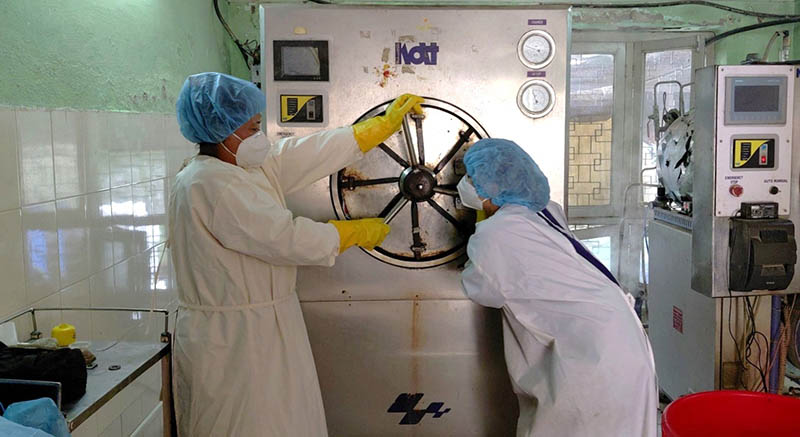
On a field visit, we found that even a few minutes inside the unit is difficult. Covering the nose becomes instinctive and breathing feels deliberate. The odor of infectious medical waste lingers on clothing even after stepping away.
Three red bins are filled to the brim with infectious waste at PMWH every day, and the waste management unit staff work in a small office with a cracked, seeping roof that often goes unnoticed, hidden in a corner of the hospital. The maroon waste bags were open, exposing materials such as used dressings, pads, gloves, gauze, and other potentially risky items.
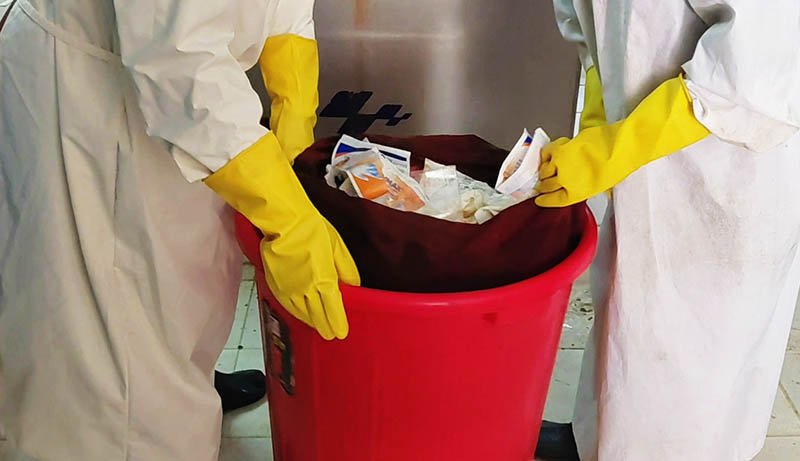
“We manually load the infectious waste into the two autoclave machines and then unload and segregate for hours,” Kiran (name changed) said. “It is harder to work in the months of summer, remaining instead whilst the autoclave machine is running, especially with the smell, yet staying outside in the harsh, blazing sun also takes a toll on us. During the monsoon, the one-storied building leaks, making it difficult for us to sit in there."
The same scene unfolds at Bir Hospital, where the waste management unit sits in the basement of a newly built building, behind a row of parked vehicles. Most of the staff who carry waste from the hospital's three buildings are women, working in a space that is dark, dusty and, as at PMWH, difficult to spend time in.
“The hospital has tried to install windows and exhaust fans wherever required in the waste management unit and also made sure that the staff is provided with personal protective gear, required training, and Hepatitis B vaccination”, said Dr. Prakash Budhathoky, spokesperson of Bir Hospital, “the hospital’s management is thinking about how to motivate the workers by organizing various events and training through performance-based indicators.”
There are piles of waste gathered at all segments of the room, whether it be for pre-treatment segregation, division of waste that has already been treated, or now to be taken away by Kathmandu Metropolitan City (KMC). Just twelve staff members are responsible for managing the sheer volume of waste brought in from three entire hospital buildings. At one end of the room, two autoclave machines remain non-functional and stand still under repair.
At both hospitals, the waste management unit is difficult to find, either tucked away in the basement or hidden in a small corner of the hospital.
According to the ‘Data Collection Survey on Waste Management in Nepal’ field report by JICA (Japan International Cooperation Agency ) published in 2024, Bir Hospital contains 900 beds and generates 544.05 kg of general waste and 323.32 kg of medical waste per day. However, accurate documents in recent years, including data on the amount of waste produced, have not been kept up to date as of 2026.
“Bir Hospital is situated at the center of the valley, and waste management is a sensitive topic for the workers, patients, and society; that is why we are focused on the management of the infectious waste produced in the hospital,” Budhathoky said.
While the hospital generates a significant amount of hazardous material, the hospital staff who spoke on anonymity said waste management practices are poor. In wards and outpatient departments, waste is often collected in open buckets without plastic linings, and different types of waste, including general and hazardous materials, are sometimes mixed into the same bucket. This lack of segregation is not only hazardous to the environment but also to the health of workers and general hospital visitors.
Non-hazardous wastes such as bottles, plastics, and others are sold to separate vendors or contractors, bringing additional income to the hospital; however, the money cannot be seen to be utilized to develop or enhance elements of the medical waste department or the waste management staff.
Waste handling is physically demanding, low-paid, and carries social stigma. Women, who often have fewer employment options in the formal sector, end up in these roles. Deepa got sick for four days, and the hospital said they would cut her salary. According to the Labour Act 2074 B.S., a laborer shall get paid sick leave for twelve days a year.
“Hospitals should provide Hepatitis B vaccinations, and since there is no vaccination for HIV, in case any staff is pricked, they should be sent to ART (Antiretroviral therapy) centers for testing,” said Deepak Adhikari, health waste consultant at Waste Management Services.
“In case the hospital does not have an ART center, there should be a healthcare waste management committee or an in-charge that has information on the nearest ART clinics, so that, in case of accidental needle pricking, they can immediately contact them and refer the staff there.”
“We have an ART center within the hospital where the staff can go as they report the needle prick injury,” said Ranu Thapa, information officer of Paropakar Maternity and Women’s Hospital, “If any staff have reported the incident to the hospital, we take care of vaccination, medication, arrange leaves, provide treatment but if the staff don't report, we would have no way of knowing.”
All the waste handlers are provided training before they join the work and are given the Hepatitis B vaccine every five years, according to an official at PMWH. These are the minimum provisions given by the hospitals, ignoring other basic requirements such as ventilation, paid sick leave, or proper first aid if any staff accidentally pricks themselves with a syringe.
“The safety precautions and basic facilities for waste management aren’t paid much attention, causing detrimental effects and negative working conditions for the staff,” said Adhikari, referring to his unpublished research that analyzed the data of waste handlers in three provinces. “We found that 60-70% of staff get pricked by the needle when we surveyed those who have worked for more than 1 year; needle pricking should not be taken lightly. ”
A 2018 study published in the Journal of Bahria University Medical and Dental College found these injuries most often occur during recapping and waste disposal. The risk of transmission from an infected patient to a health care worker after such an injury is 3-30% for hepatitis B, 3% for hepatitis C, and 0.3% for HIV.
That puts the waste management staff at greater risk. Manual segregation increases the risk of contracting diseases transmitted through syringes and other waste materials. Also, hospital waste handling should be a linear process; after touching infectious waste, everything in contact should be disinfected to prevent cross-contamination, Deepak Adhikari said.
But what we saw at PMWH was completely different; the staff stuffed the barely functioning autoclave machine with the red sack, then immediately moved to the plastic waste section of the unit without changing their protective clothing. This raises serious questions of cross-contamination, as that general waste is then handed directly to scrap collectors.
Confronted with what we observed, PMWH said the lapses are not solely on the hospital's side. “We provide PPE, vaccination and a booster dose for the workers,” Thapa said. “However, we have been lacking in providing other safety measures for several reasons, especially the physical infrastructure. We are in the process of changing our entire system and infrastructure, and that planning is currently underway.”
Waste collection begins in the morning, with staff gathering waste from all wards using color-coded bins, red for infectious waste, with other colors varying by hospital. The waste is then brought to the waste management unit, where infectious materials are sterilized in an autoclave machine, which uses high-pressure steam to destroy bacteria, viruses, and spores. Once treated, staff manually sort the waste, the most labor-intensive part of the process, separating recyclables like plastics and gloves, which are sold to vendors, from general waste, which is collected by KMC and taken to landfill sites.
The waste management staff continue their daily routine with quiet resilience. They disinfect, segregate, and manage thousands of kilograms of risk every month, yet remain invisible in the hospital hierarchy. Their white gowns, gloves, and boots protect the rest of the hospital, but little protects them in return.
“The hospital, in return, provides 1 kg of tea and sugar for their refreshment rather than a solid or even better system for waste management,” a worker said.
Cover Photo : A waste management staff member stands at the entrance of the Health Care Waste Management Center at Paropakar Maternity and Women's Hospital, Thapathali, Kathmandu. Photo by: Aditi Shrestha/ NIMJN.
Please adhere to our republishing policy if you'd like to republish this story. You can find the guidelines here.
Comments